- Home
- Our Services
- About
- Contact
- News
- Monitoring and dosing panels
- Sensys All Controllers
- Sensys All Sensors
- Sensys All Accessories
- Iwaki UK
- Iwaki mag drive pumps
- Pumps for new energy production
- Iwaki MDW
- Iwaki MDE
- Iwaki MDM
- Iwaki MDM-NP
- Iwaki MX
- Iwaki MXM
- Iwaki MX-F
- Iwaki SMX
- Iwaki MD
- Iwaki MD-V
- Iwaki NRD/RD
- Iwaki MTFO
- Iwaki MEK
- Iwaki MP
- Iwaki MMP
- Iwaki LK
- Iwaki IX-C
- Iwaki IX-D
- Iwaki IX-B
- Iwaki EH-E
- Iwaki EWN-A
- Iwaki EWN-Y
- Iwaki EWP-L
- Iwaki HRP
- Iwaki APN
- Iwaki F-series
- Iwaki SMX-F
- Iwaki MD-F
- Iwaki CFD
- Iwaki MDT
- Iwaki TC-X
- Iwaki MDG
- Iwaki GM-V
- Walchem
- Pyxis products
- Pyxis ST-500
- Guardian Pro
- Pyxis ST-590
- Pyxis ST-588
- Pyxis ST-587
- Pyxis HM-500 Series
- Pyxis ST-600 Series
- Pyxis ST-772 Series
- Pyxis ST-773
- Pyxis ST-774
- Pyxis ST-720 ST-726
- Pyxis ST-724_ST-725 _ST-728
- Pyxis ST-728
- Pyxis ST-765SS
- Pyxis RT-100 RT-200
- Pyxis CR-Series
- Pyxis CR-301
- Pyxis ST-730
- Pyxis LT-73X
- Pyxis SP-200
- Pyxis SP-350
- Pyxis SP-600
- Pyxis SP-710
- Pyxis SP-800
- Pyxis SP-910
- Pyxis PRL-100
- Pyxis FR-300
- Pyxis FR-50
- Pyxis MA Series
- Pyxis Powerpacks
- Pyxis FS-100
- Pyxis LS-200 LS-202
- Pyxis PTSA calibration solution
- Sensorex Products
- Media Transfer Range
- Brewing
- Water Treatment Range
- System Maintenance Range
- Disinfection Range
- Field Testing Range
- Reverse Osmosis
- repo
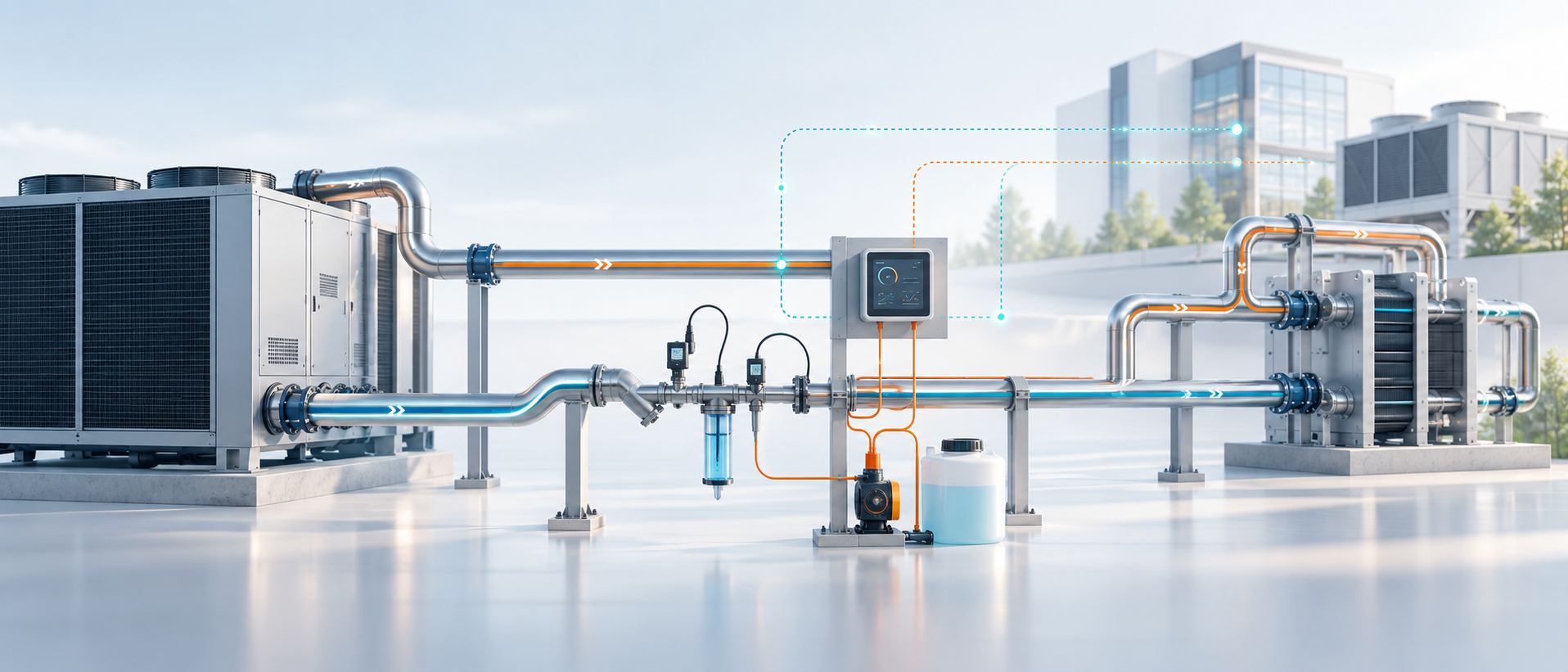
Protect closed-loop systems
Closed loop systems
Improve visibility, treatment control and chemical dosing in large closed-loop heating and cooling systems.
What should be considered when specifying monitoring and dosing for a closed-loop system?
There is no single monitoring or dosing arrangement that suits every closed-loop heating or cooling system. The correct specification depends on how the system operates, the water-treatment strategy in place and how critical the heating or cooling duty is.
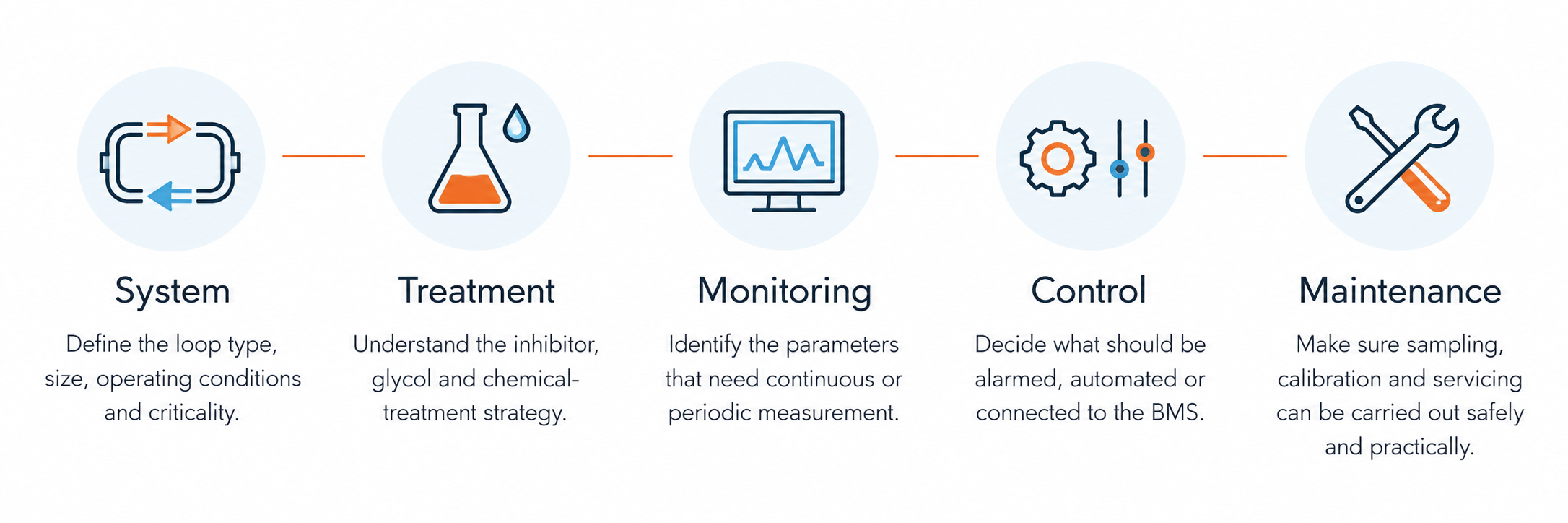
Before selecting sensors, controllers or dosing equipment, engineers should define the system conditions and the level of protection required.
Key considerations include:
For larger or critical systems, such as data centres, healthcare estates and industrial cooling circuits, the specification may also need to consider redundancy, continuous monitoring and the ability to maintain equipment without interrupting operation.
Before selecting sensors, controllers or dosing equipment, engineers should define the system conditions and the level of protection required.
Key considerations include:
- System type and approximate volume
- Number of loops or circuits
- Operating temperature and pressure
- Materials of construction
- Inhibitor and glycol requirements
- Existing or proposed water-treatment programme
- New installation, refurbishment or retrofit
- Consequences of losing heating or cooling
- Requirements for alarms, remote monitoring or BMS integration
- Access for sampling, calibration and maintenance
For larger or critical systems, such as data centres, healthcare estates and industrial cooling circuits, the specification may also need to consider redundancy, continuous monitoring and the ability to maintain equipment without interrupting operation.
Why monitor closed-loop water conditions?
Closed-loop systems are designed to minimise interaction with the outside environment, but water conditions can still change over time.
Oxygen ingress, dilution, treatment loss, contamination or inconsistent chemical dosing can contribute to corrosion and deterioration. In larger or critical systems, relying only on periodic sampling can leave significant gaps in visibility between service visits.
Continuous monitoring can help identify changing conditions earlier and provide operators with a clearer picture of how the system is behaving over time.
Oxygen ingress, dilution, treatment loss, contamination or inconsistent chemical dosing can contribute to corrosion and deterioration. In larger or critical systems, relying only on periodic sampling can leave significant gaps in visibility between service visits.
Continuous monitoring can help identify changing conditions earlier and provide operators with a clearer picture of how the system is behaving over time.
Corrosion
Corrosion can damage pipework, heat exchangers, pumps and other system components. Online corrosion monitoring can provide continuous indication of corrosion activity, while corrosion coupons provide physical evidence over a defined period.
Corrosion can damage pipework, heat exchangers, pumps and other system components. Online corrosion monitoring can provide continuous indication of corrosion activity, while corrosion coupons provide physical evidence over a defined period.
Treatment drift
Inhibitor or glycol concentration can move away from the intended operating range due to dilution, water losses, top-up or inconsistent dosing. Monitoring treatment concentration can help identify drift and highlight when corrective action is needed.
Inhibitor or glycol concentration can move away from the intended operating range due to dilution, water losses, top-up or inconsistent dosing. Monitoring treatment concentration can help identify drift and highlight when corrective action is needed.
Limited visibility
Periodic water sampling remains valuable, but it represents conditions at a particular moment. Continuous monitoring can show how the system is behaving over time and help identify developing changes between routine water-treatment visits earlier.
Periodic water sampling remains valuable, but it represents conditions at a particular moment. Continuous monitoring can show how the system is behaving over time and help identify developing changes between routine water-treatment visits earlier.
Performance
Poor water condition can contribute to corrosion products, deposits, restricted flow and reduced heat-transfer performance. Maintaining effective treatment and monitoring key parameters can support longer-term reliability and reduce reactive intervention.
Poor water condition can contribute to corrosion products, deposits, restricted flow and reduced heat-transfer performance. Maintaining effective treatment and monitoring key parameters can support longer-term reliability and reduce reactive intervention.
The aim is not to monitor everything — it is to monitor the parameters that give useful evidence about system condition, treatment and dosing performance.
What should be monitored in a large closed-loop system?
Effective closed-loop monitoring is not about collecting as much data as possible. It is about selecting measurements that give useful evidence of system condition, treatment performance and developing corrosion risk.
Sensys combines continuous online monitoring, physical corrosion evidence, controller logic and remote data visibility so changes can be identified and acted on earlier.
Sensys combines continuous online monitoring, physical corrosion evidence, controller logic and remote data visibility so changes can be identified and acted on earlier.

For larger or critical systems, continuous monitoring can provide earlier warning of changing conditions and help confirm whether water treatment and chemical dosing are performing as intended.
Setting up your Sensys closed loop system
Monitoring corrosion evidence, dosing control and remote visibility for closed-loop heating and cooling systems

| Parameter | What it indicates | Product |
|---|---|---|
Corrosion activity | Whether active corrosion conditions are developing within the system | Pyxis CR-301 continuous corrosion monitoring |
pH | Changes in water chemistry and treatment condition | |
Conductivity | Changes in ionic content that may indicate changing system conditions | |
Pressure | Pressure conditions at the monitoring point | |
Physical corrosion evidence | How system materials are being affected over time | |
Monitoring data and alarms | Whether measured conditions are moving outside defined limits | |
Chemical dosing | Whether treatment chemicals can be added accurately and under controller command | |
Multiple monitoring inputs and advanced control | How several system measurements can be brought together in one arrangement | |
Remote system performance | Trends, historical information and system visibility away from the plantroom | |
Monitor several critical parameters with one sensor
The Pyxis CR-301 combines corrosion, pH, conductivity and pressure measurement in a single sensor. This gives operators and engineers a broader view of system condition without requiring a separate device for each of these measurements.
For larger systems, bringing these measurements together can make it easier to identify developing changes and understand them in context rather than relying on a single parameter.
Combine continuous monitoring with physical corrosion evidence
Online measurements show what is happening within the system continuously. A corrosion serpentine provides a complementary method of assessing physical corrosion over time.
Used together, continuous monitoring and physical evidence provide a more complete picture of corrosion behaviour and treatment effectiveness.
Turn measurements into useful control
The Walchem Intuition 9 brings sensor information together so readings can be displayed, recorded and used for alarm or control functions.
Where automatic treatment control is required, the controller can form part of an arrangement that operates an Iwaki EWP metering pump to add treatment chemical accurately when required.
Bring multiple technologies into one closed-loop arrangement
For systems requiring more extensive monitoring and control, the Enhanced Intuition 9 board combines multiple sensor technologies with controller capability in an integrated closed-loop monitoring arrangement.
This is particularly useful where operators need a clearer view of several system conditions from one installation.
See what is happening remotely
Walchem Fluent extends visibility beyond the plantroom, allowing system data and trends to be reviewed remotely.
That can be particularly valuable for large estates, critical cooling applications and sites where engineering teams are responsible for multiple systems or locations.
The value comes from combining the measurements, control and physical evidence — not from treating each product as a standalone instrument.
A scalable approach to closed loop monitoring and control
Start with the right level of monitoring for your system and expand as risk, complexity or operational requirements increase
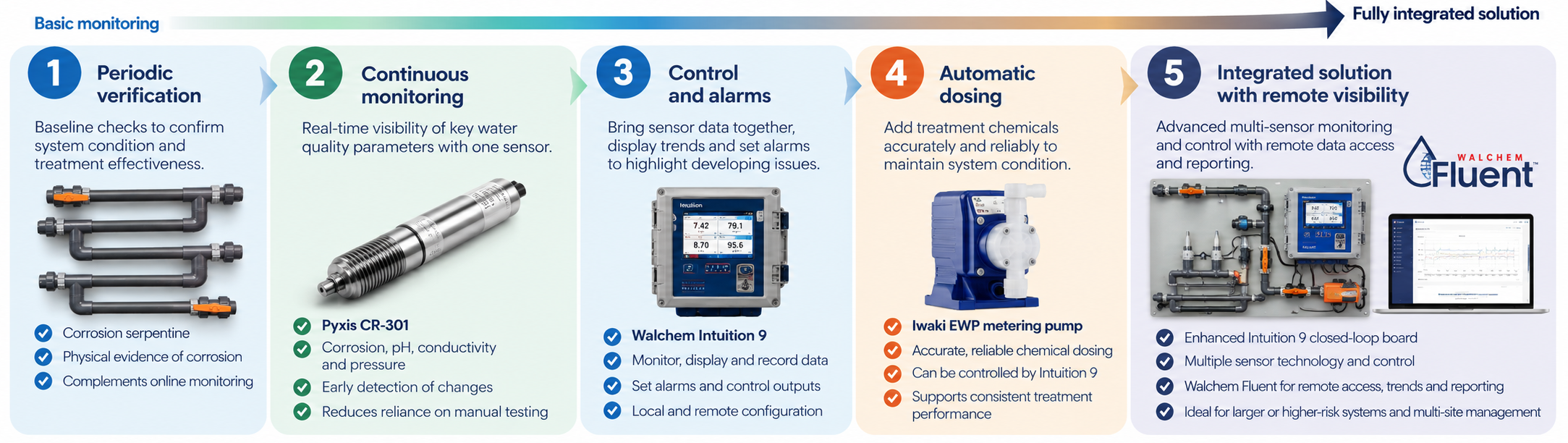
Monitor > Pyxis CR-301
Continuous corrosion, pH, conductivity and pressure monitoring from one sensor.Control > Walchem Intuition 9
Bring sensor data together for display, alarms, logging and control.Dose > Iwaki EWP
Accurate, controllable chemical dosing to support treatment stability.Verify > Corrosion serpentine
Provide physical corrosion evidence to complement continuous online monitoring.Integrate > Enhanced Intuition 9 closed-loop panel
Combine multiple sensors, control and dosing functions in one integrated closed-loop arrangement.Manage > Walchem Fluent
Access remote system data, trends and reporting across one or multiple sites.When is continuous closed-loop monitoring worth considering?
Continuous monitoring is most valuable where closed-loop systems are large, critical, difficult to inspect manually or dependent on stable treatment conditions between service visits.
Closed-loop monitoring across key applications
The priorities for monitoring, dosing and control vary depending on how the closed-loop system is used and the consequences of deterioration or failure.
Healthcare estates
Priority: continuity and long-term asset protection- Distributed heating and cooling systems
- Ageing infrastructure
- Trend data and early warning
- Maintenance without disrupting critical services
Commercial buildings
Priority: performance and lifecycle cost- Heating and chilled-water condition
- Stable treatment levels
- Reduced reactive maintenance
- Improved visibility between service visits
Industrial closed loops
Priority: process continuity and equipment protection- High or variable temperatures
- Unusual materials or chemistry
- Process-critical cooling
- Chemical compatibility and tailored monitoring
Data centres and critical cooling
Priority: resilience, visibility and continuity- Continuous corrosion and treatment monitoring
- BMS integration and remote alarms
- Redundancy and maintainability
- Repeatable monitoring designs across halls or phases
District and communal heating
Priority: network condition and remote visibility- Large system volumes
- Multiple assets and circuits
- Long-term corrosion monitoring
- Centralised alarms and data
Standard or tailored closed-loop monitoring system?
A standard arrangement can work well where the system duty, monitoring parameters and control requirements are straightforward.
More complex or critical systems may need a tailored design to accommodate multiple loops, higher temperatures, unusual pressures, additional sensors, specialist communications or more advanced dosing and alarm requirements.
More complex or critical systems may need a tailored design to accommodate multiple loops, higher temperatures, unusual pressures, additional sensors, specialist communications or more advanced dosing and alarm requirements.
Standard arrangement
Suitable where:- Single loop or straightforward system layout
- Conventional operating temperature and pressure
- Standard monitoring parameters
- Simple alarm requirements
- Known chemical dosing duty
- Straightforward installation and maintenance access
Tailored arrangement
Consider where:- Multiple loops or circuits need to be monitored
- Heating or cooling is operationally critical
- Temperatures or pressures require specialist sample handling
- Multiple sensors or dosing duties are required
- Duty/standby dosing is needed
- BMS integration or remote communications are more complex
- Space, access or panel layout creates installation constraints
- Specific alarm logic or control sequences are required
The aim is to match the monitoring and control arrangement to the system risk and operating requirements, rather than adding complexity where it is not needed.
Support from Sensys
Sensys works with customers to match Iwaki pump technology to real process requirements.
Whether you are reviewing an existing process, replacing a pump, designing new equipment or working in an emerging energy application, Sensys can help identify a reliable and practical pump solution.
Call: 01438 759595
Email: sales@sensys.co.uk
Whether you are reviewing an existing process, replacing a pump, designing new equipment or working in an emerging energy application, Sensys can help identify a reliable and practical pump solution.
Call: 01438 759595
Email: sales@sensys.co.uk
We can help with:
- Pump selection for new or existing applications
- Chemical compatibility considerations
- Replacement and upgrade discussions
- Energy-conscious pump selection
- New energy production applications
- High-risk industrial and process environments
- Dosing, transfer and circulation requirements
- Technical support and after-sales advice
PRODUCTS
MANUFACTURERS
APPLICATIONS
ABOUT
Join our mailing list

Follow us on LinkedIn

Head Office
24 Vision Park
Preston Place
Upper Caldecote
Biggleswade
SG18 9GQ
01438 759 595
enquiries@sensys.co.uk
Preston Place
Upper Caldecote
Biggleswade
SG18 9GQ
01438 759 595
enquiries@sensys.co.uk
